EmArchive
Weekly Roundup – Geomorphology Lesson Daily – April 17
Here’s a look back at the last week of #GeomorphologyLessonDaily. We’re compiling these lessons with high schoolers in mind, but the content can be used for other levels as well.
Underwater views
Monday
Check out this video to see how woody structures & coarse bed material can form turbulence in channels. You can also watch fish interacting with that structure & with the camera operator, whom they like to trail because he stirs up the bed.
#STEM
STEAM in Action
Tuesday
There’s more than one way to learn about your watershed. Here’s a brilliant example.
“Collected Watershed” is a beautiful, immersive, and interactive art piece by Stacy Levy. In order to create the piece, she collected water from every tributary in the Towson area. Wow! Fantastic work Stacy!
Towson University article + video
From artist Stacy Levy
#sciencelesson #interdisciplinary #STEM #STEAM #watershed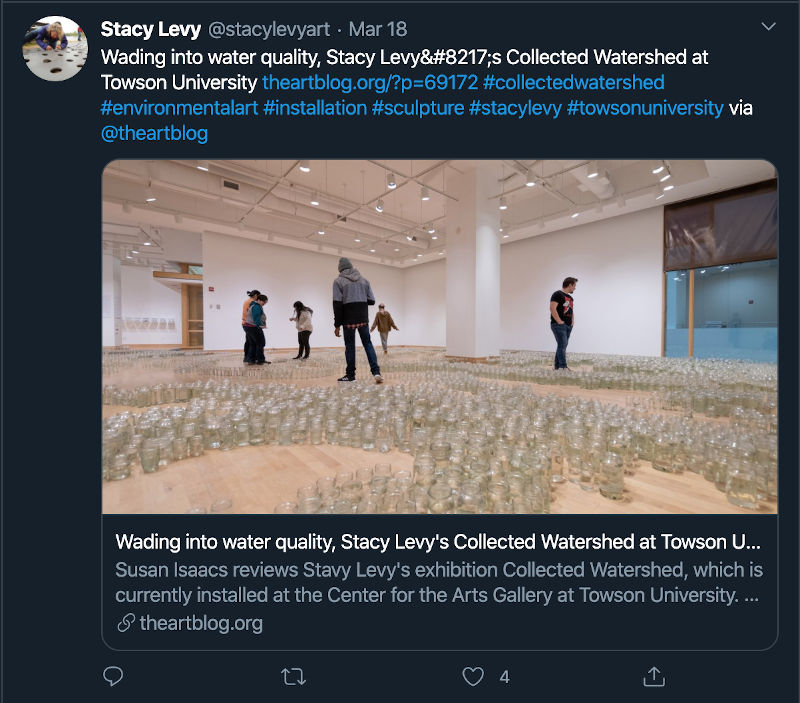
What does a forest manager do?
Wednesday
Hear from Andrew Berry about what he does at Bernheim Arboretum and Research Forest.
“Our mission is connecting people with nature. Our vision is becoming global leaders in ecological stewardship”.
Check out other PechaKucha presentations too! 20 images shown/talked about for 20 seconds each.
#forestry #stewardship #oldgrowth
Turn the kitchen into a glacier experiment
Thursday
One of the best ever videos on glaciers!
Awesome work by Time For Geography.
#homeschooling #scienceexperiment #remotelearning #STEM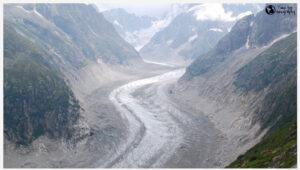
Frozen waves?
Friday
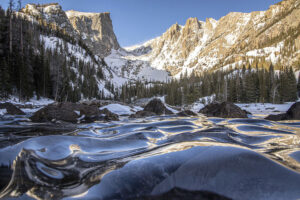
Wow! Who knew ice could be so beautiful! Photographer Eric Gross captured these surreal alpine landscapes in Colorado’s Rocky Mountain National Park.
“Appearing as if wind-swept waters were frozen in time, these sleek wave-like curves are believed to result from melting snow re-freezing, then being carved and contoured by wind and snowdrift. This ground-level perspective provides a view that seems other-worldly, reflecting so strongly that one could be forgiven for thinking it’s a lake of flowing liquid metal.
This seems to be a rare or not-well documented phenomenon, or perhaps an extreme example, as very few photos of wavy frozen lakes can be found online, nearly all of them coming from Rocky Mountain National Park this season.”
-Life As A Nomad, Eric Gross
#STEM #LearnAtHome