FAQ
FAQ
Does Emriver sell outside the US?
Yes! Contact us for a quote and shipping estimates.
Does Emriver offer discounts to non-profit organizations?
Almost all our customers are educational or non-profit entities, so we do not offer additional discounts.
Why does Emriver use plastic as the sediment in the models?
When it comes to modeling sediment transport, ground melamine offers several advantages over lithic sand:
- It has a specific gravity of ~1.6, which makes it about 60% the density of sand. The lower density allows for mobility at lower flow rates and slopes and decreases the time required to observe changes in the landscape.
- With post-industrial ground melamine, we can color-code our sediment mix to enhance visual effects and make variations in depositional stratigraphy visible.
- The lighter weight makes handling and transporting easier.
- The plastic media will not damage the pumps or components in our models. More information about our media can be found here.
Is the Emriver modeling media made of microplastics?
Yes. Plastic particles under 5mm diameter are considered microplastics, and this describes all the particles in our mixes. We are very aware of the importance of keeping microplastics out of the environment, which is why all of our systems come with multiple filters to keep particles from entering water systems.
Can I use sand in an Emriver stream table?
Emriver boxes are strong and durable, but are not approved for use with sand (lithic material) as the box or supports could collapse under the increased weight. Sand can also clog pumps and filters and damage other components in the models.
Can I mix non-coded (Alpha) Emriver media with color-coded (Carbondale, Memphis) media?
If you do, you lose the effective purpose of the color-coded media.
Is it possible to separate the different sizes/colors of particles?
Yes, it is possible to use screen sieves to separate out the different colors. Our media page lists the size ranges for each color. There will always be a very small amount of overlap, but you can achieve good separation. This being said, very few of our customers go through this process, and continue to keep the media mixed in the box, allowing the stream to provide the sorting.
How do I keep my Emriver modeling media clean?
In short, the best way to maintain your modeling media is to keep the water clean and allow the media to dry as often and thoroughly as possible.
Here are the recommended steps for daily maintenance:
- After using the stream table, allow the water to drain from the box.
- Dump any media from the sediment trap back into the box.
- Use the scoops to mound up the media in the upstream half of the box. This will allow the bulk of the water to drain out of the sediment overnight.
- If the stream table will not be used for a while, take the time to dry the media thoroughly before storing it. Choose whichever drying method is best for your setting.
- Spread the media out in the box to create more surface area exposure. Stir it occasionally to expose the wet media. A gentle fan can help speed up evaporation, but make sure you do not blow the drying particles out of the box.
- If you are in a dry, warm environment, you can dry the media outdoors in the sun. You will need to protect the media from being blown away by the wind, and from being contaminated by pollen or other organic material.
- A waterproof heating mat, like one used for seed starting, can be used under the media to speed the drying.
- If you have access to a soil oven, or any oven with low heat options, you can dry batches of media on trays. The melting point of melamine plastic is 345⁰ C/653⁰ F. Keep oven settings at or below 200⁰ C/400⁰ F.
- Change the water after each use, or at minimum, once a week. Use your judgement to evaluate the need based on use and the number of hands in the model over a session.
- If the water is changed regularly, it is not necessary to add bleach or other disinfectants. (CAUTION! Chlorine can catalyze the corrosion of aluminum. Never add chlorine directly to the aluminum box. Also, never leave saturated media stagnant in the aluminum box for long periods of time; municipal water has sufficient levels of chlorine to corrode the aluminum if left in contact with the aluminum for long periods of time. Stir the media as described above.)
- If you need to keep the water in the reservoirs for an extended time, here are a few methods for keeping the water sanitary:
- Add a small amount of bleach to the reservoir. Dosing recommendations are in your manual as well as on the yellow sticker on your stream table box. A 25ml graduated cylinder is included in your toolbox. Do not pour bleach directly into the aluminum box.
- Em2 use 6 ml bleach
- Em3 use 12 ml bleach
- Em4 use 21 ml bleach
- Use bromine in similar doses to the bleach. Alternatively, you can use a floating spa dispenser in the reservoir with bromine tablets.
- Add a small amount of bleach to the reservoir. Dosing recommendations are in your manual as well as on the yellow sticker on your stream table box. A 25ml graduated cylinder is included in your toolbox. Do not pour bleach directly into the aluminum box.
- If the media needs to be stored in buckets before fully drying, add 10 ml of bleach to each 5-gallon bucket. If possible, leave the lids open enough to vent the media.
- With the aluminum box and the reservoir(s) empty, wipe them with a mild cleaner (but not chlorine bleach!) to remove any film.
How do I deep clean the media if it develops a biofilm or a funky odor?
If the media develops a strong odor, or if you simply want to do a thorough cleaning (e.g., at the end of a semester before a break), here are some recommended methods.
1. Rinse the media thoroughly with clean water. This can be done by using a hose to spray the media in the box, while allowing the water to drain from the reservoir. This way, you will not be recirculating dirty water.
2. Remove the media from the aluminum box and put it in the plastic 5-gallon buckets, or larger plastic containers if available.
3. Without the risk of damaging the aluminum, you can use much higher concentrations of disinfectants. The particles have a lot of surface area, so the more you can expose it through agitation or stirring, the more effective your cleaning will be. Here are some options:
-
- Bleach
- Hydrogen peroxide
- Bromine
- Unscented Febreze
(CAUTION! Do NOT mix these disinfectants together. It is your responsibility to understand the safe application of these chemicals.)
4. Rinse the media thoroughly with clean water.
5. If the odor persists, or the water remains dirty, repeat steps 1-4 above.
6. Dry the media thoroughly using any of the methods described above.
7. With the aluminum box and the reservoir(s) empty, wipe them with a mild disinfectant to remove any film.
In the streambed, it appears the coarse particles are transported faster than the fine particles. Why is this?
When it comes to bedload transport, conventional wisdom says that the finer the particle, the more easily it will be mobilized and transported in the stream flow. This is true in most situations. In the stream table, however, you will often see an inversion of this; the larger particles will move more easily and more rapidly than the finer particles. This is the consequence of the low flow rate and shallow depths in the model.
Briefly, the velocity profile in an open channel is zero at the point of contact with the channel floor and maximum at the surface. Just above the point of contact at the floor of the channel is what is called a viscous sublayer. In this layer, the flow velocity will be close to zero. The higher the flow velocity, and the higher the turbulence in the stream, the smaller this layer will be. Additionally, surface roughness can affect the flow at the point of contact. Particles can effectively armor the floor, preventing the entrainment of particles in the stream flow.
Keep in mind that we are not scaling down the viscosity of the fluid in the stream table, and our flow rates are low. The finer particles (red and black in our color-coded mixes) are small enough to remain in the viscous sublayer and armored floor, while the larger particles can be caught in the stream flow. This is why you can see the larger particles slide or saltate over the finer particles in the stream.
It is possible to see the particles behave as expected in the stream table when the flow rates and/or depth are sufficiently high, such as when running a flood sequence or at the leading edge of a delta.
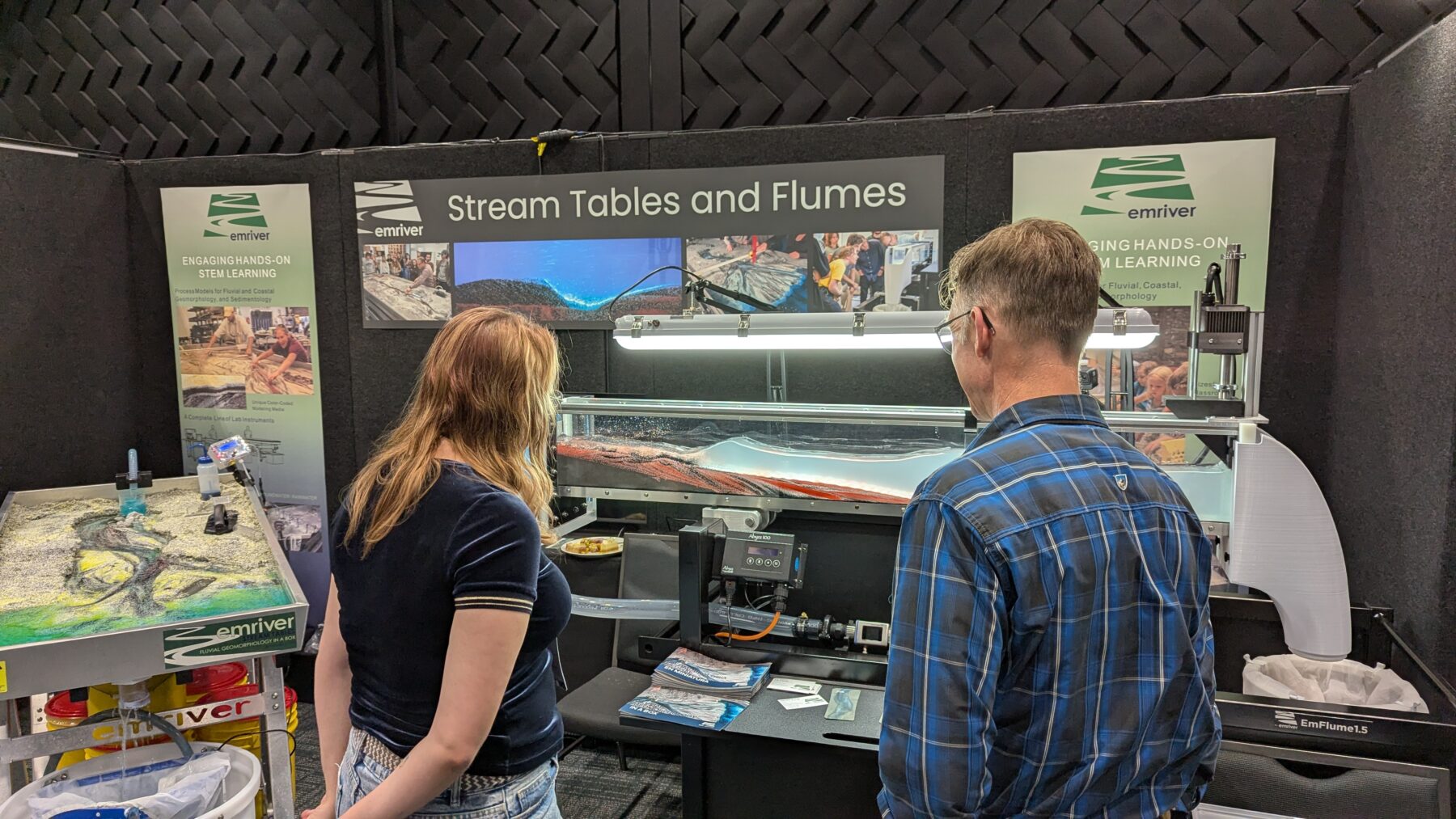
In the EmFlume1.5, there is higher depth and water velocity, so the sediment transport is more typical.
How do I disassemble and store an Em2?
For detailed instructions, see the Em2 Setup Manual here.
Can the models demonstrate coastal or tidal processes?
Yes! Lake/sea level can be changed by raising and lowering the standpipe at the downstream end of our models. The addition of the Emriver Wave Maker can add coastal and estuarine morphology to your modeling repertoire. With the Wave Maker, you can simulate a variety of processes, including longshore drift, sediment delivery from river mouths, and, with our color-coded media, particle sorting by these processes.
A Wave Generator is also available for the EmFlume1.5, allowing for the demonstration of effects of mangroves or break walls on wave energy
Can the stream tables demonstrate groundwater or precipitation?
Yes. Please link to read a detailed description of the Emriver Groundwater/Rainwater system.
Do you offer fee-based research or modeling?
We do not conduct experiments on behalf of outside researchers, but work continually to improve our models for client use in research and education.
Does Emriver build custom stream tables or flumes?
We are a small staff and devote our time to building and improving our current product line. However, if you have a special need, feel free to run it by us and we’ll see what we can do.
Can Emriver stream tables be used outdoors?
Yes. The Emriver Em2 was designed with portability in mind, and our customers often take them to outdoor STEM events and outreach programs. However, the modeling media should not be left outdoors when not in use; you do not want microorganisms (or macro-raccoons) to find a home in your stream table. All components should be protected from freezing and excessive heat.
Are Emriver products appropriate for my students’ age and level?
Yes! Just as a microscope can provide learning, exploration, and insights for a first grader as well as graduate student, our stream tables are used by students at all levels. Our models are often used for education outside academic environments as well, teaching land owners, professionals, recreational river guides, road crews and legislators about streams, rivers, and coastlines. The EmFlume1.5 is most appropriate for university or upper level high-school students.
What maintenance is required for the stream tables?
All our products are designed for long life. The primary task in caring for a stream table is keeping the media and components clean. Because there is moisture and a lot of surface area, attention needs to be paid to avoid biofilm in the media. Detailed instructions for taking care of your Emriver product are contained in the user manuals.
What are the spatial and time scales of these models?
This is a very good question and one we cannot answer definitively. Direct scaling of all the variables in river morphology and processes is not possible, so the relationships are approximate. Simulating specific situations, such as modeling and predicting whether a certain section of river will be stable or not, is difficult or impossible in any physical model.
As an example, a 1m wide fan delta in an Emriver stream table can resemble a fan that is 1000 meters in nature. However, if the 1mm particles in the model were scaled similarly, the fan would be made of 1m diameter boulders. Conversely, if we tried to scale down the sand from a real-world delta, we would have 1-micron particles that would be invisible to the naked eye and remain suspended in the model flow.
Although precise scaling is very complicated, our models are remarkably effective at demonstrating a variety of fluvial, coastal, and estuarine processes. This article by Professor Chris Paola addresses the question thoroughly.
Can I use an Emriver stream table to model a specific water feature in my locale?
When the modeling media is wetted, it can be shaped into any landscape you like. However, once the water flows, the results will vary with each iteration. To create a scale model of a local stream, you would need to create a rigid form as an insert into the stream table. Our models effectively demonstrate how flowing water changes a landscape, but may not replicate the erosion and deposition in a specific location.
Can a stream table be used like an augmented reality sandbox?
Many educators are familiar with an interactive tool called an AR (augmented reality) Sandbox. It uses a Microsoft Kinect 3D camera to project a colored topography onto the sandbox in real time as users alter the landscape. Some customers have used our plastic media instead of sand for this application, taking advantage of its lighter weight. The Kinect can also be used on our stream tables to better visualize the topography. However, it is not possible to get a good measurement of, or projection onto the water in the table; it is too reflective. Laser scanning is a better alternative.
What kind of quantitative analysis can be applied to the models?
Photogrammetry and LIDAR scanning have both been used to quantify and analyze changes in the stream tables over time, and researchers are continually developing faster and more accurate tools in this field. In-channel flow analysis using PIV, PTV, ADV and pitot tubes can be applied in the EmFlume1.5. However, the flow in the stream tables is most often too low and shallow to apply these methods.