Why Physical Models?
Why Physical Models?
Through personal experience, observation, and the news, people are aware of the conflicts between humans and rivers and coastlines such as flooding, drought, and destruction of infrastructure. Streams have been altered for flood control, navigation, and other needs, often negatively affecting the physical and biological functions of flowing waters. These alterations are among the most tangible and pressing environmental problems we face. To make sound river and coastal restoration a reality, more active engagement in scientific processes is essential in training future geoscientists and in fostering informed decisions on science and societal issues.
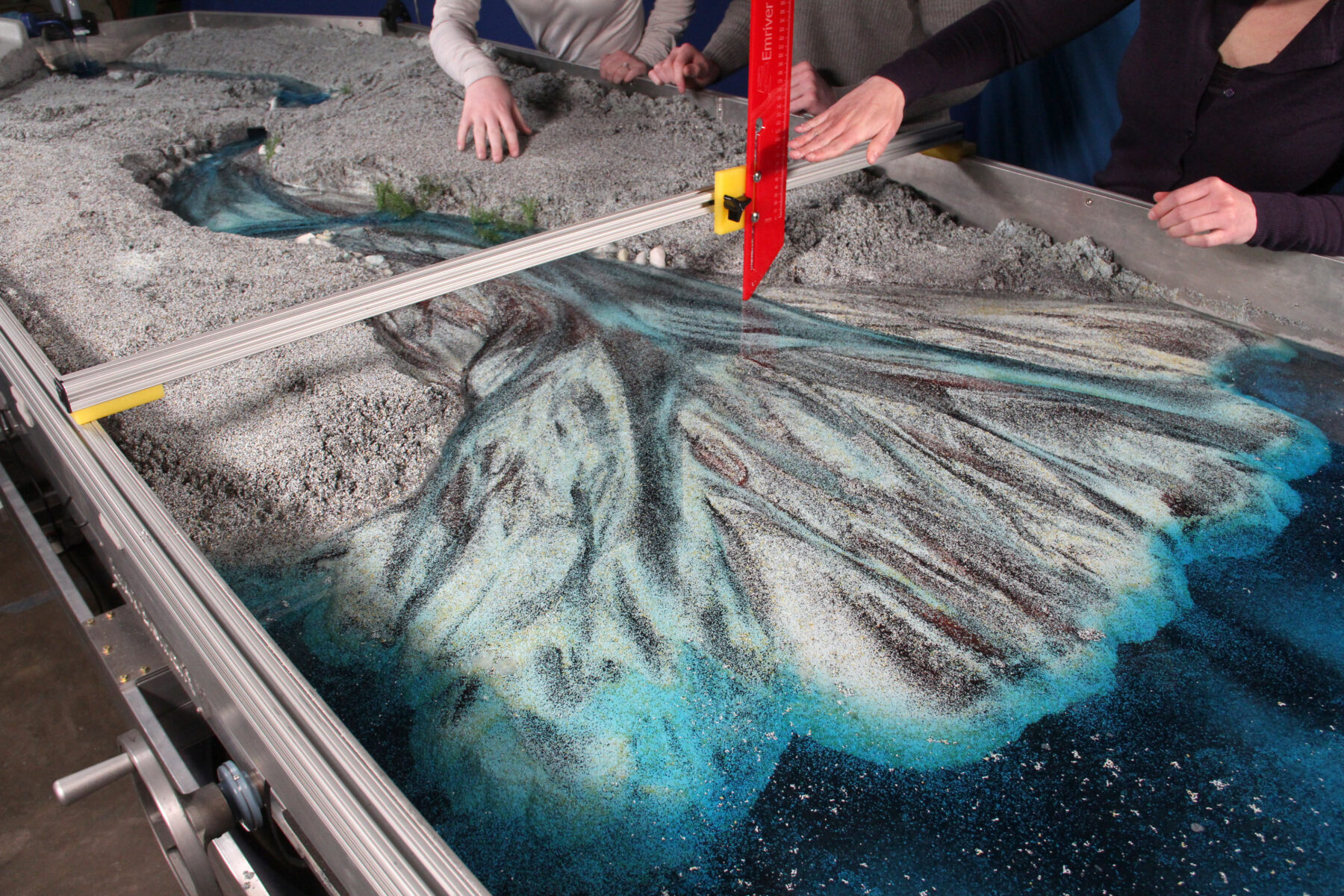
Emriver models, also known as stream tables or moveable bed models, use flowing water and moveable media to simulate sediment. These models help meet science education challenges by connecting science to everyday life. They realistically and dynamically simulate a wide range of fluvial and coastal processes and enable learning tied to real-world problems and solutions.
Without physical models, students observe a static, post-erosion river, look at pictures and video of the river in its current state, or study historical geological events. The river model transforms observation into hands-on interaction and encourages experimental activities tied to fundamental geomorphic processes. Using stream tables to study rivers also provides a powerful means of teaching STEM (Science, Technology, Engineering, Math) principles and puts the students in control of their learning.
This kind of teaching engages students, fosters critical thinking skills, develops positive attitudes towards STEM, and prepares the next generation for a world where interaction between humans and rivers and coasts will be increasingly important.
Multidisciplinary
Emriver stream tables can be used in a wide range of disciplines and applications. The images and table below provide an overview of the topics and exercises that can be used in different educational settings when talking about, for example, why and how rivers meander.
What makes Emriver models different
Other moveable bed river models are limited in their usefulness. They’re small, and their narrow widths are inadequate to properly show river meandering processes. Their smaller size and box perimeter also limit the number of students who can observe. The Em2 can easily accommodate a dozen students; Em3 and Em4 can accommodate even more.
See the models in use
Various pages on this website feature videos of the models in use.
In addition, our YouTube channel includes all of our videos, plus a playlist of River Geomorphology videos filmed using an Emriver Em2 model. Each video in the playlist includes a description.