Engineering
Emriver Models in Engineering Education
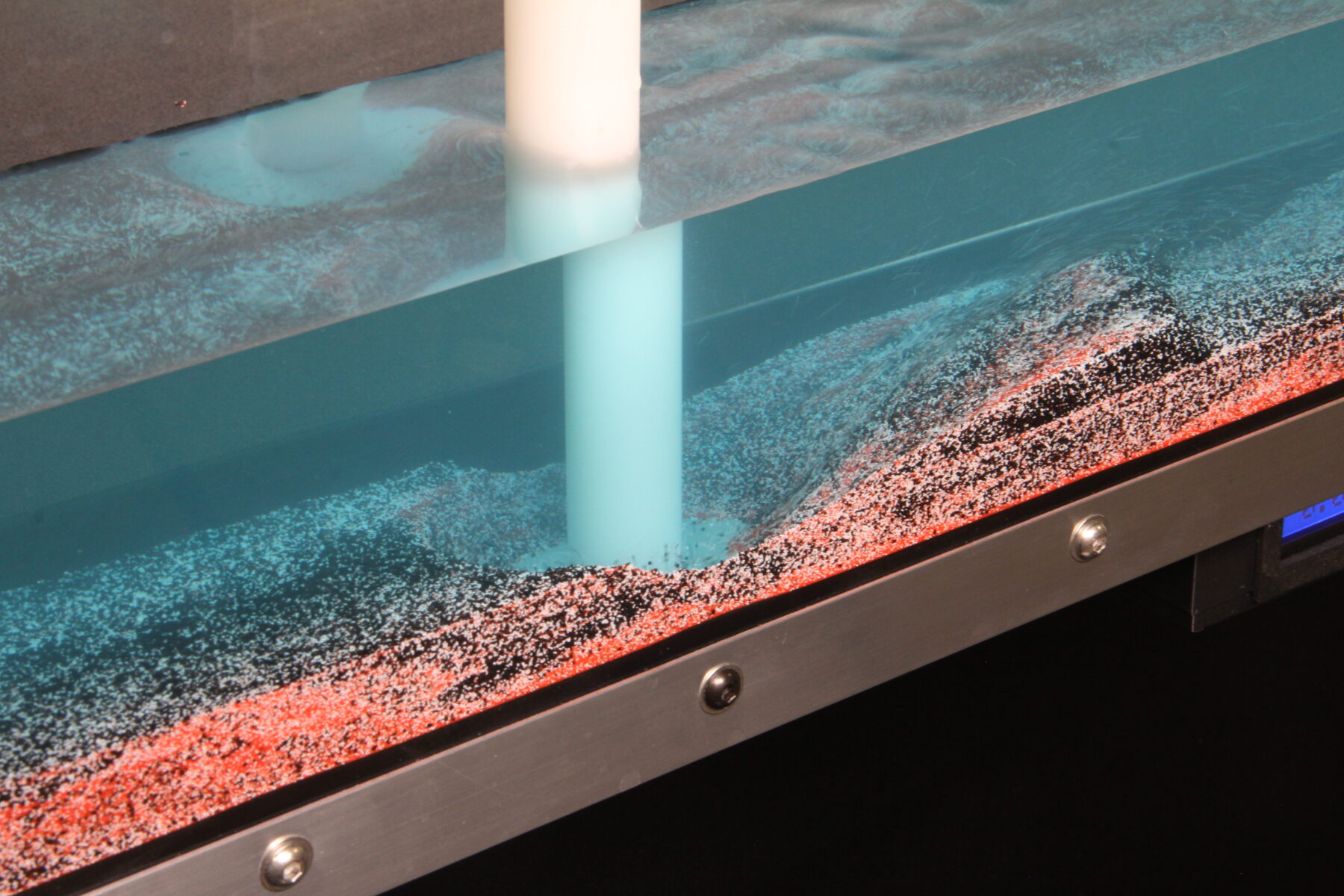
Emriver models are especially suited for teaching river dynamics in water resources and civil engineering, as well as demonstrating principles of fluid mechanics. The stream tables and hydraulic flume are easily set up in a classroom or lab for hands-on demonstrations and interaction in a simulated experience for better understanding of engineering principles. Professors and their universities will find the models an ideal recruitment tool to attract students to a department or lab.
Example Topics and Lessons
The EmFlume1.5 Example Topics
- Open channel hydraulics
- Uniform flow
- Turbulent, transient and laminar flow using Reynolds number
- Velocity and discharge
- Velocity profiles
- Subcritical, critical and supercritical flow-Froude number and specific energy
- Manning’s equation and roughness coefficient
- Hydraulic jump
- Conservation of specific energy with sluice gate
- Discharge over weirs: sharp-crested, V-notch, broad, ogee
- Flow through orifice
- Culverts
- Sediment transport in fluvial systems
- Incipient motion and bedload transport
- Ripple and dune morphology and migration
- Scour around piers and other hydraulic structures
- Coastal morphology (with addition of EmFlume1.5 Wave Generator)
- Wave and beach interactions
- Differential sediment transport
- Impact of different coastal structures on sediment retention and erosion
- Wave attenuation through mangroves and other kinds of roughness
Stream Table Example Topics
- Dams
- How upstream and downstream slopes affect the stability of the dam
- How seepage occurs and its effect on dam stability
- Effect of reservoir water level on dam stability
- Levees
- How side slopes affect the stability of levees
- Effect of levee spacing on flow and levee stability
- Effect of flow depth on levee stability
- Culverts
- Effect of culvert on flow and channel erosion
- Effects of culvert size on flow and channel erosion
- Effect of deposition on culvert capacity
- Bridges
- Effects on flow and erosion
- Measuring basic characteristics of flow through media
-
- Seepage velocity of dry media and saturated media
- Slope variables and equations
- Measuring flow and discharge
- Groundwater behavior
- Stream surveying; cross sections and long profiles
- Hydrographs
- Effects of channelization, bank armoring, streambed mining
Examples of Emriver in Applied Engineering
Rivers and Roads Program
The Vermont Agencies of Natural Resources, in partnership with the Vermont Agency of Transportation, developed the Rivers and Roads Program using the Emriver Em2 geomodel to explain how rivers work and how to design, construct, and maintain roads and bridges to create greater river stability and more flood-resilient transportation infrastructure.
- Read the Case Study
- See the Training packet courtesy of Vermont Department of Environmental Conservation
- Watch the Video about the program
Tidelands
Tidelands is a partnership between Engineering with Nature (EWN), Auburn University’s Landscape Infrastructure Design Lab (LIDL), the University of Virginia’s Natural Infrastructure Lab (NIL), and the University of Pennsylvania’s EMLab.
All three institutions own and use our Em4 Stream Tables to help understand, visualize and communicate the impacts of different approaches to infrastructure design. “Our five-year project is advancing research and development into new forms of natural infrastructure for bays and estuaries on the Atlantic and Gulf coasts of the United States.”
Learn more about their projects here: https://tidelands.us/
See more Video examples!